Atlanta City Hall mayor’s office
A Man in FullAtlanta City Hall mayor’s office is both a civic interior and a political threshold in the novel: Roger Ahlstrom White II comes seeking the favor of his old fraternity brother, Mayor Wesley Dobbs Jordan, and the building’s spaces give visible form to the difference between public authority and private access. Roger passes from an imposing marble rotunda through a reception area into the mayor’s suite, where the Fareek Fanon case is discussed; later, the route continues down to an underground garage. The sequence makes City Hall not merely a backdrop but the setting in which friendship, status, and the handling of a highly public matter meet.
Setting and Architecture
The relevant offices occupy the second floor of the 1989 addition to City Hall, entered from Trinity Avenue. Roger first encounters a lobby that is at once modern and grand: gray Georgia marble rises three stories to a dome with a skylight, while marble stairways lead to a balcony whose immense brass railing circles the rotunda like a crown. The architecture is striking enough to unsettle Roger’s usual impatience with modern design. He recognizes the place as impressive even though his own taste favors work from an earlier architectural period.
That upward movement also gives the space a political scale. The stairways and balcony lift the visitor from the public lobby toward the mayoral domain, while the rotunda’s height and crown-like railing make the approach feel ceremonial. Roger’s thought that Wesley Dobbs Jordan has made it is bound to this interior: Jordan is not simply a former college acquaintance but the mayor of Atlanta, presiding over a setting whose grandeur Roger compares to a kingdom and a throne. The comparison belongs to Roger’s perception, but it captures how the building’s design enlarges the authority he is about to petition.
Reception and Access
Beyond the doors of the mayor’s domain, a long modern counter marks the transition from the public route to the controlled office area. A black receptionist greets Roger warmly and tells him to take a seat; the reception area also contains a large white policeman at a desk. Roger notices the arrangement of the black receptionist and white officer, but her welcome is so friendly that he stops monitoring the interaction for signs that he is being treated as an ordinary petitioner. The scene places ordinary reception and visible security side by side, while Roger’s personal recognition alters his experience of both.
The difference between formal waiting and privileged entry becomes clearer on a later visit. Roger reflects that he had not needed to wait with Miss Beasley and the policeman: Gladys Caesar had been stationed to receive him and escort him directly into the mayor’s suite. He calls this VIP treatment a small matter to himself, even as his presence there confirms the value of his first-name relationship with Jordan. City Hall thus has more than one route through it. The counter and waiting area suggest a process for visitors; Roger’s connection allows that process to be bypassed.
The Mayor’s Salon and the Fanon Case
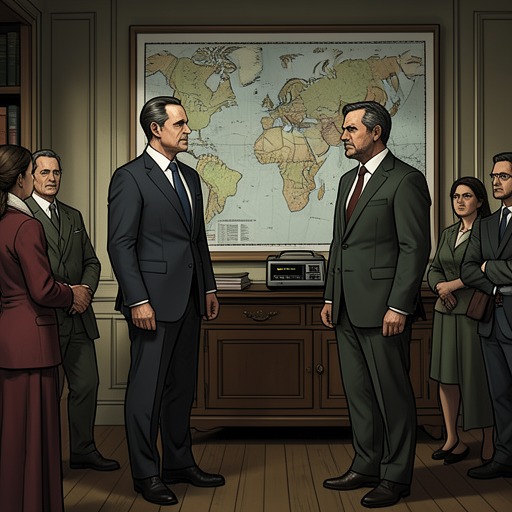
The mayor’s salon is a more intimate setting for political conversation. Roger sits on a white tweed couch while Jordan settles into a large armchair across a coffee table. On a later occasion, Roger sinks back into the same couch and surveys the room’s ebony walls and Yoruba ivory ceremonial swords. The furnishings distinguish this private suite from the marble rotunda: the lobby announces civic grandeur, whereas the salon is arranged for conversation, reception, and decision-making within the mayor’s own domain.
It is in this setting that Roger raises the football player Fareek Fanon with Jordan. The office’s significance is practical as well as symbolic. Jordan explains that he had invited Inman Armholster to meet him after Roger’s suggestion, and recounts proposing that the matter be referred to Georgia Tech’s student government Sexual Harassment Committee. In Jordan’s view, that body might be better placed to ascertain the facts and reach a decision quietly than the police or court system. The discussion connects the mayor’s private office to the public pressure surrounding the allegation, including the risk that the identity of Armholster’s daughter could attract attention. The salon is where the proposed alternative is voiced, not where the case is resolved.
Movement Beyond the Suite
City Hall’s sequence of interiors continues below ground. After Roger calls Roberta Huffers and Jordan speaks with Gladys Caesar, the two head down a small stairway to an underground parking garage. There a chauffeur, Dexter Johnson, waits beside a pearl-gray Buick sedan with its rear door already open. Jordan introduces Dexter to Roger as his old fraternity brother and counselor; they shake hands, and Roger finds Dexter’s enormous fingers difficult to encompass with his own hand.
The garage changes the scene’s scale once more. The marble rotunda frames public authority, the salon accommodates confidential political discussion, and the garage provides the departure point for the mayor and his visitor. Dexter’s waiting car and the open door make the transition from conversation to movement immediate. Across these spaces, access is repeatedly made concrete: Roger is welcomed at reception, ushered into the suite, and then accompanies Jordan out through a private route. City Hall’s narrative role lies in this progression, which turns Roger’s old connection to the mayor into physical passage through the institutions and rooms where Atlanta’s public business is conducted.